
Procurement is key to organisation’s operational efficiency, ensuring the right goods and services are acquired at the right time, cost, and quality. In sectors such as mining, oil and gas, and construction, where projects involve complex logistics, high-value equipment, and strict regulatory compliance, effective procurement can make or break project success. A key distinction within procurement is between direct and indirect procurement. Understanding the differences, and knowing how to manage both, is crucial for businesses aiming to optimise costs, reduce risk, and maintain a competitive edge.
This blog explores direct and indirect procurement, examples, and strategies to balance these for efficiency. Whether you’re in heavy industry or a service-oriented business, these insights will help strengthen your supply chain.
What is Procurement?
Procurement is the process and strategies involved in sourcing, negotiating, and acquiring goods and services that an organisation needs. While often associated with purchasing, procurement also involves:
- Strategic sourcing and supplier management
- Contract negotiation and risk mitigation
- Ensuring compliance with industry standards
- Optimising cost, quality, and delivery
In industries like mining, oil and gas, and construction, procurement is particularly critical due to the high capital investment, certain regulations, and risks associated with projects. Procurement decisions directly impact project timelines, safety, and profitability.
Direct Procurement
Direct procurement refers to the sourcing of goods, services, and resources that are directly involved in creating a company’s products or delivering its projects. In industrial sectors, these are the items that directly contribute to project delivery. These purchases directly influence the production process, project timelines, and the quality of the final output.
Direct procurement is crucial because it ensures that all core materials, machinery, and services are available, reliable, and of the required quality. Any disruption in direct procurement can result in project delays, increased costs, and potentially safety or compliance issues.
Examples of Direct Procurement
In mining, oil & gas, and construction, direct procurement might include:
- Mining: Excavators, drilling rigs, conveyor belts, blasting materials
- Oil & Gas: Pipelines, valves, pumps, drilling equipment
- Construction: Structural steel, cement, concrete, heavy machinery
Characteristics of Direct Procurement
Direct procurement is defined by several key features:
- Impact on Project Output: Direct procurement affects the quality, timing, and cost of the final product or project.
- Long-term Supplier Relationships: Companies often form strategic partnerships with suppliers to ensure reliability and favourable terms.
- Focus on Quality and Compliance: Since direct materials are in production or project execution, they must meet strict quality and safety standards.
- Supply Chain Dependency: Delays or issues in direct procurement can delay operations, showing the need for strong risk management and planning.
- Cost Sensitivity: Material and equipment costs directly affect the project budget, making strategic sourcing essential.
Challenges in Direct Procurement
Direct procurement has several challenges because it involves materials that are essential for production. Common issues include supply chain disruptions, price fluctuation of raw materials, and long supplier lead times, all of which can delay production and increase costs. Maintaining consistent quality is also difficult, as poor inputs directly affect the final product. Also, businesses may become overly dependent on a limited number of suppliers, meaning higher chances of operational risks and reducing flexibility.
Strategies for Effective Direct Procurement
- Supplier integration: Collaborate with suppliers to improve forecasting and delivery schedules.
- Strategic sourcing: Diversify suppliers to mitigate risk while maintaining quality.
- Technology: Use procurement software and ERP systems to track orders, inventory, and supplier performance.
- Cost analysis: Evaluate not just purchase price but long-term operational costs, maintenance, and reliability.
Direct procurement involves analysing project requirements, predicting demand, assessing supplies, negotiating contracts, and monitoring supplier performance to ensure operational smoothness.
Indirect Procurement
Indirect procurement refers to the sourcing of goods and services that support the business’s operations but do not directly affect the creation of the final product or delivery of a project. While indirect procurement does not have a direct impact on project output, it is key for operational efficiency, cost management, and overall organisational productivity.
Indirect procurement includes a wide range of categories, often including items and services that are overlooked, yet they represent a significant portion of business spend. Because indirect procurement is frequently less structured than direct procurement, it creates opportunities for cost optimisation.
Examples of Indirect Procurement
- Office supplies, IT equipment, and software
- Safety gear and protective equipment
- Office management services (cleaning, utilities, waste disposal)
- Training programs and consultancy services
Characteristics of Indirect Procurement
Indirect procurement is defined by several key features:
- Lower individual cost: Items are often less expensive than direct materials, but collectively significant.
- High volume and variety: A wide range of categories across multiple suppliers.
- Operational dependency: Indirect procurement affects productivity and compliance rather than direct output.
- Large Supplier Base: The wide variety of products and services involved usually means dealing with multiple suppliers across different categories.
Challenges of Indirect Procurement
Indirect procurement challenges are mainly due to limited visibility and control over spending. Since purchasing is often decentralised, organisations experience maverick spending, lack of standardisation, and a varied supplier base. These challenges can reduce cost efficiency and compliance. Also, indirect purchases are sometimes treated as low priority, making it difficult to measure value and optimise processes, which can lead to inefficiencies and unnecessary expenses.
Learn more about Maverick Spending in our whitepaper here.
Strategies for Effective Indirect Procurement
-
Category management: Group similar indirect spend to negotiate better contracts.
-
Automation: Implement e-procurement tools to streamline requests and approvals.
- Supplier consolidation: Reduce the number of suppliers for efficiency and volume discounts.
- Regular audits: Monitor compliance, quality, and spend effectiveness.
Direct vs Indirect Procurement
The primary difference between direct and indirect procurement is their impact on the product or project outcome. Direct procurement directly influences production and project completion, while indirect procurement supports operational effectiveness.
Understanding this allows companies to allocate resources, manage risk, and develop procurement strategies that align with both operational priorities and budget constraints.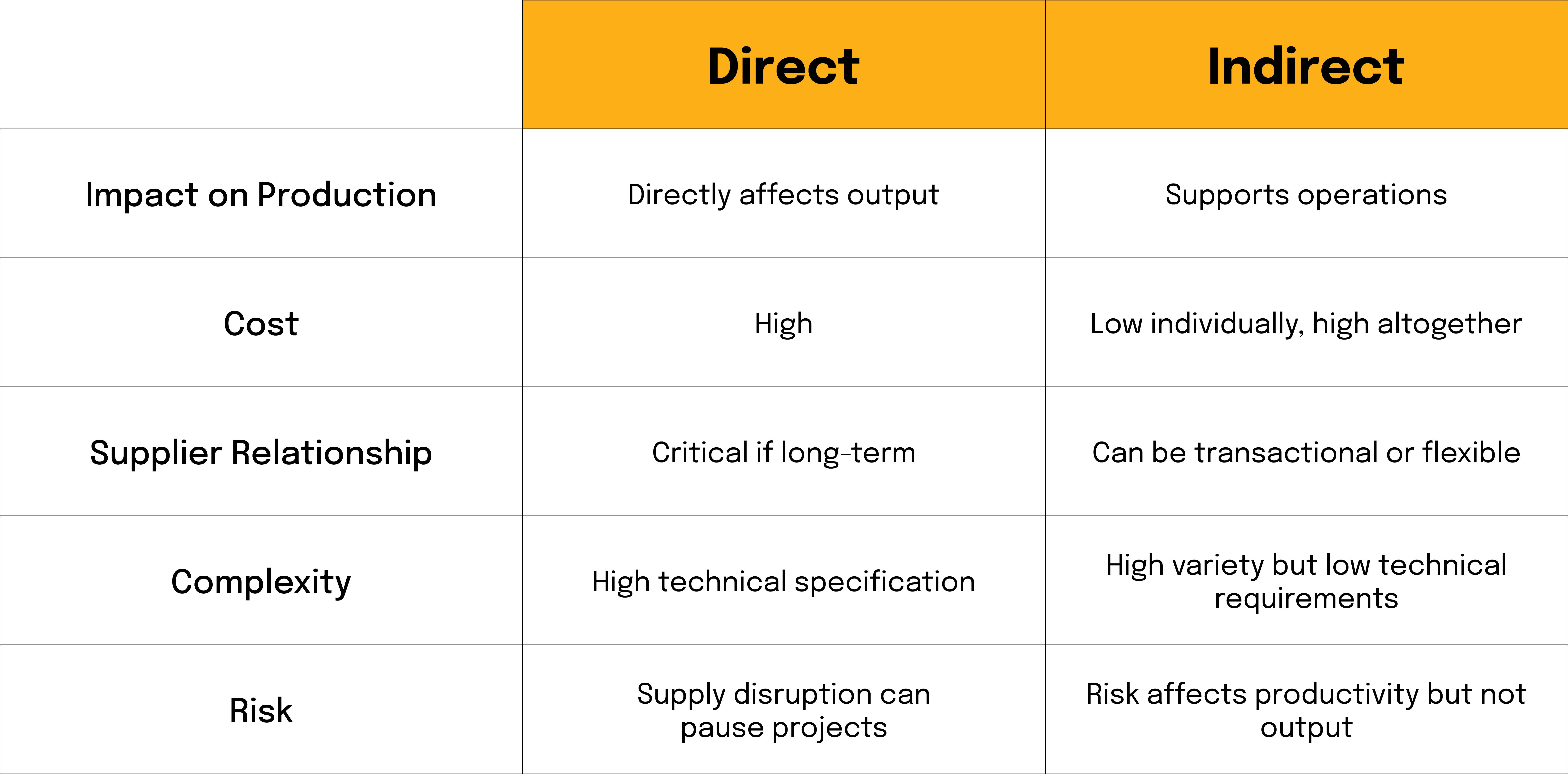
The Importance of Balancing
Balancing direct and indirect procurement is crucial for efficiency and cost control. Overemphasising direct procurement can lead to underinvestment in other important areas of the business. However, neglecting direct procurement can result in delayed projects, production hold-ups, and cost overruns. A strategic approach ensures both categories are optimised to support overall business objectives.
Trends Within Procurement
Procurement is evolving rapidly, and organisations in mining, oil & gas, and construction are increasingly adopting innovative practices:
- Digital transformation: AI, automation, and predictive analytics streamline sourcing, forecasting, and supplier evaluation.
- Sustainability focus: Companies prioritise eco-friendly sourcing and initiatives.
- Supplier collaboration: Strategic partnerships reduce risk and enhance supply chain resilience.
- Data-driven decisions: Real-time spend and performance analytics inform cost-saving and efficiency strategies.
These trends impact both direct and indirect procurement, driving efficiency, risk mitigation, and sustainability in high-stakes industries.
Best Practices
- Implement a centralised procurement strategy to coordinate direct and indirect spend.
- Have a supplier performance evaluation to monitor relationship management.
- Use technology for procurement automation, spend analytics, and supply chain visibility.
- Prioritise risk management in sourcing, especially for high-value direct procurement.
- Regularly review and optimise indirect spend to reduce waste and improve operational support.
- Ensure collaboration between procurement, operations, and finance teams.
By combining these practices, you can maximise efficiency, minimise risk, and maintain cost control across both procurement categories.
To conclude, understanding the difference between direct and indirect procurement and managing both strategically is essential for any indsutry. Balancing these ensures that essential project materials are delivered on time, while operational systems are optimised to ensure productivity, compliance, and safety. As procurement changes with more digitalisation and sustainability trends, companies that create a data-driven approach will have stronger project outcomes and a competitive advantage.
At Storm Procurement, we help businesses take control of both direct and indirect procurement through strategic sourcing, supplier management, and tailored procurement solutions.
To learn more about our services, capabilities, and industry expertise, explore our product brochures.